Showing posts with label Blue Hills. Show all posts

Wednesday, April 1, 2020

Kitsap County Geology: Green Mountain, Gold Mountain, and the Blue Hills.


I'm back. And no foolin'. 

The volcanic plateau of Yellowstone National Park that I call home is closed, set to reopen in the future at some as yet undecided date due to the pandemic sweeping the globe. I'm currently in Kitsap for the time being, socially isolating and eagerly awaiting any news. So during this lull, I got out the technological feather duster and opened this blog up after a...*quick mental math*... two-year absence. My sincerest apologies to devoted readers out there. 

Everyone in Kitsap County knows about Green Mountain, our forested little peak rising to an altitude of 1,710 feet, the second-highest peak on the Kitsap Peninsula. Gold Mountain to the south beats it out by 50 feet, reaching 1,761 feet. Green and Gold Mountains are the two highest summits in a cluster of hills referred to collectively as the Blue Hills. The Blue Hills is an official name accepted by the United States Geologic Survey, I would love for it to become common usage. Wishful thinking? probably, but you heard it here first!

Terrain map of the Blue Hills. on the Kitsap Peninsula. The city of Bremerton lies on the right side of the image. Kitsap Lake in the right-center. 
The Blue Hills emerge like the tip of a rocky iceberg from the center of the Kitsap Peninsula in a sea of glacial deposits. The glacial deposits have their own story, but that's a tale for another time. What are the Blue Hills made out of anyways? 
Components of Igneous Rocks
 (Click image to view full size.)
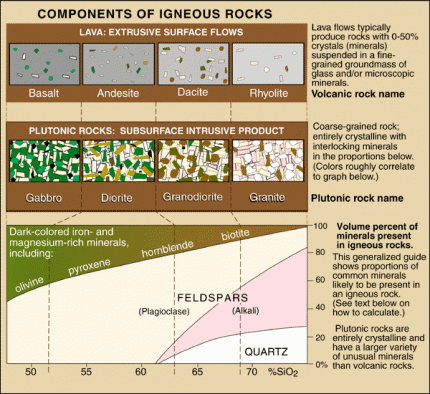
Chart from the USGS about igneous rocks and their mineral components. Surprisingly, you can find examples of almost every rock on this chart in the Blue Hills. 

The chart above illustrates different igneous rocks and their mineral components. Igneous rocks are rocks formed from magma or lava. If the rock is formed from magma below the surface, it is called an intrusive rock. If the rock is formed above the crust as a result of magma erupting onto the surface as lava, it is an extrusive rock. The Blue Hills are made up of both intrusive and extrusive rocks.

The primary rock composing the Blue Hills is gabbro. Gabbro is a coarse-grained, dark-colored, intrusive igneous rock made up mostly of the minerals plagioclase feldspar and pyroxenes. Gabbro is the intrusive equivalent of the most common extrusive volcanic rock on earth, basalt. Basalt is also present in large quantities in the Blue Hills. Gold Mountain is completely made of basalt, and the large rock outcrops you can see on the north shore of Sinclair Inlet alongside Highway 3 are basalt lava flows. Basalt from the eastern edge of the Blue Hils is mined and used in landscaping and construction purposes. Many of the rock retaining walls you can find around the Kitsap Peninsula were mined from the Blue Hills.
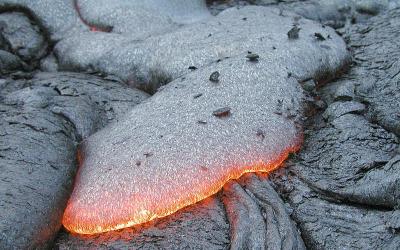
Hot basalt lava flowing over the surface of a cooled basalt lava flow.
 (Click image to view full size.)
A typical basalt lava flow. Photo by USGS. 

Following the emplacement of the gabbro and basalt of what would become the Blue Hills, the whole mass of rock was invaded by a swarm of structures known as dikes. Dikes are tabular or sheet-like bodies that intrude into existing rock units vertically or near vertically. When exposed they can look like narrow vertical cracks filled with volcanic or sedimentary material. Two kinds of rocks form the dikes that riddle the Blue Hills. Some of the dikes are andesite, a volcanic rock made up of mostly plagioclase, similar to basalt, but containing some quartz, which is rarely found in basalt. The other type of rock is dacite, another volcanic rock which has an even higher percentage of quartz than andesite (See chart above).

The final drop of "Gold Creek Cascades" goes over a dike of andesite. 
So, where can you see these rocks? Unfortunately, if there's one thing that Kitsap geology isn't, it's being easy to see. Right square in the center of the Pacific Northwest, our lush vegetation and vibrant growth hides most of the rocks from our sight. I already mentioned the most easily visible outcrop of rock in the county, the cliffs of basalt towering over highway 16 on the north shore of Sinclair Inlet. Aside from that, there are exposures of gabbro and basalt on the way up to the summit of green mountain, with the main viewing area (currently closed as of this writing) being built on the edge of a large basalt cliff. If you know the location of "school rock/turtle rock/eagle rock" on the south flank of Green Mountain, that is composed of gabbro. And there are a couple blink-and-you-miss-it outcrops of rock along the south side of Holly Road as it skirts the base of Peak 1291.

There are other stories to be told about the geology of the Blue Hills that I left out of this post for the purpose of time and the fact that scrolling for long periods is universally hated. I do plan to stay diligent though and see if I can get the flow going on this blog again. I can't promise multiple posts a week. But hopefully, something between 1-5 posts a month is what I'm shooting for. If there's one thing I love more than geology, it's telling other people about geology. And I've learned a LOT since I last worked on this blog. I think it's time to share some of that. Until next time!

Monday, February 5, 2018

Kitsap Waterfall Survey: "Lower Lost Creek Cascades"

Well over a year since I've last surveyed a waterfall on the Kitsap Peninsula, this was a nice return to form. Several months ago, a friend of mine mentioned to me the existence of a small cascading type waterfall on Lost Creek within publicly accessible land. With me being busy at CWU, it was put on the back burner at the time. Not anymore, This past weekend (2/4/2018) I joined my friend, his son, and their dog and set out to document and photograph this cascade with my own eyes.

Our waterfalling dog companion, Delilah.
A half-mile after it's opening fanfare, Lost Creek encounters another outcrop of Siletzia bedrock which underlies much of the Kitsap Peninsula. The canyon walls and creek bed become lined with a gorgeous blue-green-gray basaltic rock. After tripping over a small rapid in the shadow of a massive fir stump, the creek flows around a bend and slides over a ten-foot drop into a beautifully secluded alcove with a surprisingly deep plunge pool.

The initial 10-foot drop of "Lower Lost Creek Cascades" 
Immediately after this drop, the creek narrows from 10 feet wide to less than 3 feet and careens through a narrow slot cut into the rock, dropping an additional 4 feet in the process. The force of the water tearing through this slot has drilled large circular potholes into the bedrock, making interesting shapes and formations.

Lost Creek tearing through the small defile, with several large potholes in the foreground
Immediately after the main slot, the creek funnels through another bottleneck in the rock in a slide 3 feet high slamming into a jutting rock, taking a 90-degree turn to the left and bouncing over a couple small drops, before leaping over a messy 5-foot rock face. This final drop ends in a rocky alcove similar to the large one upstream. Shortly downstream, "Lower Lost Creek Cascades" terminates in a final small 3-foot slide, bringing the total height to ~25 feet.

The bedrock lining the creekbed. 
The geology of the canyon here is both fascinating and stunning. The underlying grey-blue gabbro rock sets the tone, peppered with red-brown pieces of basalt, and cut with white veins of quartz and calcite. In quieter pools and gravel bars, occasional light colored granite clasts can be found from the overlying glacial debris mantling the entire peninsula. At least at one spot within the cascade, I found evidence for faulting and the intrusion of volcanic andesite dikes 50 million years ago. I plan to write posts on both those geologic stories in the near future.


Saturday, January 30, 2016

Kitsap Waterfall Survey: "Claire Falls"

There are multiple places in Washington State where a very respectable and sometimes spectacular waterfall is nearly eclipsed by an even bigger one nearby. It just so happens that there is one of these situations in Kitsap County. It turns out, "Tin Mine Falls" has a much smaller sibling.

During the wet times of the year (fall/winter/spring), small ponds and rain runoff give rise to a quaint little brook along the mountainside between Tin Mine Creek and a smaller tributary to the west. This tiny stream, nearly imperceptible on topographic maps and imagery, babbles through the forest, running generally northeast, straight towards Tin Mine Creek's canyon. Just downstream of "Tin Mine Falls," the brook intersects the near-vertical basalt canyon wall of and promptly dives over it. The resulting 40+ foot ribbon-like waterfall is startlingly beautiful, and would be commanding the attention of everything around it if it wasn't dwarfed by its colossal neighbor.

The lower section of "Claire Falls" as it's namesake looks on. Photo by Micah K. 
It is likely that this fall runs dry by July or August, but when it is flowing, it is a beautiful sight indeed, and so I have it included in my survey. After I first saw it in January 2015, I was trying to think of a name for it for months. One day a good friend of mine visited, and I took her to see "Tin Mine Falls." While she enjoyed "Tin Mine Falls" immensely, she also took an extreme liking to this little ephemeral fall. Because of this, I decided to name the fall after her.  

Tuesday, January 12, 2016

Kitsap Waterfall Survey: "Heins Creek Cascades"

Heins Creek in the southeastern portion of the Ueland Tree Farm  has already revealed a major waterfall: "Heins Creek Falls", which crashes over 50 feet just before entering Heins Lake. But I have long suspected the creek has more in store as it winds its way down from the Blue Hills.

Some of the reddish basaltic bedrock in the streamed. Photo by Micah K. 
Just under a half mile upstream of "Heins Creek Falls," Heins Creek encounters another layer of basalt bedrock. While the resulting cascades are not nearly as spectacular as its larger cousin downstream, they're still respectable, set in a beautiful green setting and bouncing off of colorful rocks. Here the creek trips over a long series of drops over the course of about 100 feet, similar to the layout of "Gold Creek Cascades" on the other side of the Hills. The total height of this cascade is about 25 feet, well above the ten foot requirement for my survey. It should be noted that this point in the creek may experience times of very low flow during summer months.


The uppermost section of "Heins Creek Cascades," Photo by Micah Kipple. 


Monday, December 21, 2015

Kitsap Waterfall Survey: Tin Mine Creek Revisit 12/13/15

The week prior to December 13, the Kitsap Peninsula had enjoyed a thorough and much needed dousing of steady rain. The creeks predictably swelled in response, and I knew exactly where I wanted to go first. It had been nearly eight months since the last time I visited "Tin Mine Falls" back in March, and it was time to go see the survey's largest waterfall again.

Tin Mine Falls 12/13/15
Photo by Micah K.
Hiking up the dampened GM-1 road, it became quickly apparent there was going to be a lot of water in the creek. Every little side gully and low spot had water in it, and the branches were still dripping. 40 minutes after parking the car, My hiking partner and I finally arrived at the creek. When my friend Spencer and I had first discovered Tin Mine in January 2015, it was full of water, crashing through the basalt canyon. I didn't think it would be possible for the creek to get any more filled, but apparently it is; the swollen spectacle that greeted us on December 13 was nothing short of astounding. The creek was absolutely thundering through the canyon. Arriving at the best spot for viewing I like to call "The Overlook" I came face to face with the entire display.

It became readily apparent to me that we weren't going to be able to make it to the bottom of the largest tier, which requires scrambling up and over the lowest tier of the falls. The amount of water made it nearly impossible, if not downright dangerous. So after watching and photographing "Tin Mine Falls" for a few minutes, we moved towards "Echo Falls," and got another shock.

Usually I access "Echo Falls" by rock hopping across the creek about 50 feet upstream of the falls. This is no longer possible. It appears one of the many windstorms that has slammed the peninsula recently caused 3-4 large pine trees to fall into the creek, shattering and creating a natural dam. The creek has pooled up 3-4 feet deep behind this dam, inundating the once perfect crossing, it's now wade across, or cross a log a little bit more upstream.

Once we successfully crossed to the other side, we scrambled down to "Echo Falls". For the first time I have seen, It was completely full. Words can almost not do it justice.

Echo Falls 12/13/15
Photo by Micah K. 


Sunday, November 29, 2015

Kitsap Waterfall Survey: "Kerplunk Falls"

This fall was surveyed a while ago. But I had never written a post about it, so I have decided to fix that.

Lost Creek is one of the largest creeks flowing out of the Blue Hills. It comes down off the eastern slopes of Green Mountain and flows east until it joins with Wildcat Creek to form Chico Creek, which is has one of the best salmon runs on the Kitsap Peninsula. I had long suspected Lost Creek to have a fall somewhere along it's upper reaches, assuming it was a permanent stream. I made the 2 mile hike around Green Mountain to where an old logging road crosses the incipient creek.

Starting upstream, I almost immediately entered into a deep basalt gorge lined with old pillow lava, through which Lost Creek flowed. I scrambled and fought my way up the gorge, becoming rapidly frustrated with the lack of vertically falling water. Finally, probably about 300 or so feet up the canyon, I found a fall, sort of.

"Kerplunk Falls" 
As the creek takes a sharp righthand bend, it has become dammed up with a rather impressive logjam immediately over a small 10 foot basalt ledge. After filtering through the logjam, the creek plunges straight down over the drop, landing in a shallow alcove and continuing along its way. When I first observed this fall, the appearance of the logjam reminded me of the child's game Kerplunk and so I have tentatively named this small waterfall "Kerplunk Falls"

I suspect this canyon has more to offer above "Kerplunk," however at the time of the survey, I was too exhausted to continue further up the canyon, I scrambled up to the rim and began walking back down towards the road. As I walked down the slope along the rim, I noticed numerous signs of bear frequenting the area, A reminder that this is bear country.


Wednesday, November 25, 2015

Kitsap Waterfall Survey: "Contact Cascades"-My 20th waterfall!

Following my lecture at the Norm Dicks Government Building in Bremerton, one of the audience members came to me and told me of a waterfall on the Beaver Pond Trail within the Green Mountain State Forest. Their description seemed to indicate something small, but they insisted it was over bedrock, and so I decided to investigate.

As the wind howled through the trees and branches of various sizes fell all around, I hiked up the side of Green Mountain until I reached the Beaver Pond Trail. Within a few hundred feet, the trail crosses over Grata Creek, a stream running down the northwest side of Green Mountain. Grata Creek has long been on my radar, as it drops rather rapidly from high up on the mountain slopes before emptying into Tahuya Lake.

Lidar imagery map of Grata Creek. 
Even with these suspicions, I realized that most of the creek was bounded by private property, and so any falls and cascades would be inaccessible to me. Grata Creek originates on a spring fed lake tucked at the head of a forested valley at about 950 feet. The creek flows from this lake and bypasses another lake. It is after this second lake the creek steepens significantly and the private property begins. This is is the only place I thought falls would occur. I was wrong

Shortly after exiting its source lake Grata Creek meanders through some open pine forest, then less than a quarter mile later, it passes underneath the Beaver Pond Trail bridge, and immediately skips over a series of wonderful cascades over 20 feet in height, right next to the trail and very easily visible.

Bridge over Grata Creek
On my survey I was only able to observe 4 tiers in detail, there may be one or two below these, but I was unable (and really, unwilling) to fight through the thick brush to see them, so they will have to wait for a later visit. Of the tiers I did observe:

 The cascade begins with a five foot sliding drop over some beautifully dark volcanic rock called  Gabbro.

First tier "Contact Cascades" 
The second tier is a little more complex; two-thirds of the creek pours into a deep crack in the bedrock, while the remaining portion slides gradually down the rock. Here some interesting geology is seen. On the north side of the stream the bedrock is composed of the Gabbro the first tier goes over, but on the south side of the stream the rock is Basalt, which upon close observation, has even formed into small disorganized six-sided columns. In geology, the term used for where two different rock types meet is called a "contact." Thus, since this cascade appears to occur on a contact, I have named it "Contact Cascade."

Second tier of "Contact Cascades" 
The third tier is a small little three footer choked with forest debris and relatively ugly, the 4th tier is a long sliding cascade probably five or six feet high. After this the creek appears to go over at least one more drop, but heavy brush prevented me from getting an up close look.

Thanks to the person who suggested this fall to me. It is a great contribution to the survey!

One final thing to note, "Contact Cascade" is my 20th surveyed waterfall! Hard to believe I've made it this far after starting this project a year ago. Who knows, maybe I'll find 20 more!

Monday, November 16, 2015

Kitsap Waterfall Survey: "Heins Creek Falls" Revisit, November 15, 2015

Today I had the pleasure of leading two reporters from the Kitsap Sun newspaper to "Heins Creek Falls." A story by the Kitsap Sun is out to precede my lecture on Thursday.

The day started out almost perfect: overcast skies with almost no wind and a comfortable temperature. I had high hopes as I went through my classes of the day at OC. Unfortunately, Washington had other plans. As soon as I stepped foot outside the building of my last class the sky opened up, and continued raining for the majority of the day. At 2pm I was scheduled to meet up with the reporting team; they arrived right on schedule.

Not wasting any time, we trudged up to the railroad tracks and started toward our destination. We passed by Kitsap Creek, and peered up at "White Train Falls" through the trees; the water was tinted a slight tan color and roared through the canyon. With that much water I doubted I would ever be able to make it up to the fall the way I did before.

"Heins Creek Falls" at high water/flood stage
Finally, after what seemed like a long while of trudging through the ceaseless rainfall, we rounded the bend and the roar of a swollen Heins Creek came to meet us. Scrambling up the sopping almost unrecognizable path to the main tier, my excitement grew exponentially as more and more of the falls came into view; it was absolutely torrential.


Heins Creek was probably two feet higher than normal water level in some places. The main 20 foot tier, which normally is a graceful segmented sliding cascade, was a careening mass of foaming whitewater crashing down the basalt face. In some places, the water hit jutting outcrops of basalt with enough force to create small but powerful rooster tails. When the creek encountered the massive logjam, instead of draining through it, the astounding amount of water was forcing the creek to flow over the logs, plunging down into the large alcove. The final 10 foot cascading section was still recognizable, but a lot more violent as well.

As well as being extremely excited myself, I was pleased to look over and see the reporters with smiles etched on their faces. One remarked "I never knew something like this even existed in Kitsap, this is amazing." Watching waterfalls alone is one thing, but seeing people's reactions to their first sight of them sometimes is even better.

Video of the Falls. 

Sunday, October 11, 2015

Kitsap Waterfall Survey: Upper Wildcat Creek

Wildcat Creek is one of Kitsap County's largest salmon streams, producing healthy runs of Chum and Coho salmon each year. Being one of Chico creek's largest tributaries, it has naturally been on my radar for some time.

Upper 5' section of "Bobcat Cascade"

Wildcat Creek is born in the same natural saddle that houses Tin Mine Lake; drained to the west by Tin Mine Creek. After flowing out of the saddle, even after heavy rains, Wildcat Creek is small, being only 3-5 feet wide at most and less than a foot deep. It meanders through the forested valley for less than a mile before it is crossed by Rock Quarry Road, and several hundred feet later, Wildcat Trail.

100-200 feet after the trail bridge, Wildcat creek encounters the basalt formations that make up the core of the Blue Hills. The creek drops over the first layer in a rather unimpressive two tiered cascade with respective drops of 5 and 10 feet. For the small size of this cascade, and for it's location on Wildcat Creek, I named it "Bobcat Cascade."

Somewhat disappointed at the size of the cascade, I forced myself to continue following the small creek, passing several more cascades to small to be included in the survey. Convinced that the creek had more to offer, I pushed downstream, crawling over logs, traversing steep slopes, and hoping there was another cascade or fall further down. Sure enough, I rounded a corner and the sound of hissing water echoed throughout the canyon.

After another several dozen feet, I found myself standing on the brink of a very steep, multi-tiered cascade, crashing down a rugged face of black basalt. Scrambling down alongside the fall, I carefully took notes of the different drops and their heights, here's what the results were:

Looking up the largest cascading drop of "Cougar Falls" 

The falls consists of 3 main sections, all within about 150 feet of stream length.

The first section consists of a one foot, two foot, and four foot drop.
The second section is that largest, with a fifteen foot steep cascading drop.

The third section is a seven foot shallow cascade over basaltic rock with a striking orange-red color, bringing the total height of this fall to thirty-five feet.

Third bottom section of "Cougar Falls" note the tawny color of the rocks. 


This orange color, which shows up in other parts of the basalt gorge the creek runs through; reminded me of the color of a Cougar, and thus, keeping in the theme of Wildcats, I named this fall, "Cougar Falls"

Thursday, April 30, 2015

Kitsap Waterfall Survey: "Wright Creek Falls"

Wright Creek is a small creek sandwiched between the Blue Hills and the western outskirts of Bremerton. Its headwaters begin in a small series of spring-fed wetlands on peak 730's eastern slope. A few hundred feet after exiting these wetlands, the stream drops into a small canyon just southwest of Bremerton's #3 reservoir. At the head of this canyon is a ten-foot-high basalt headwall covered with a thick layer of green mosses. Wright Creek plunges over this headwall into a shallow plunge pool in the form of a small, but startlingly pretty twelve-foot horsetail waterfall. Upon exiting the pool, the creek steps down several small basalt ledges, before heading into the thick growth of the canyon.

"Wright Creek Falls" during moderate flow.

 About 100 feet to the northeast of "Wright Creek Falls" is a tributary of Wright Creek with its own name; Charlston Creek, which drains a separate set of marshes to the north. Charlston Creek encounters the same basalt outcrop as Wright Creek and careens down a set of bouncing cascades 15 feet high. Only the top few feet of the cascades can be seen because the rest disappears under an impressive logjam that crosses the tributary. The logjam is so compact that soil has formed on the top and forest undergrowth is flourishing, creating a natural tunnel. Because of this feature, I have tentatively named the cascade, "Tunnel Cascade."

The upper portion of "Tunnel Cascade" on Wright Creek's Tributary. Photo by Micah K.
I know of another waterfall or cascade on Wright Creek reportedly large enough that it blocks all fish passage upstream, but unfortunately this fall is likely on private property. However, Wright Creek does have another feature downstream of "Wright Creek Falls," Which is discussed here 

Saturday, February 28, 2015

Kitsap Waterfall Survey: "Jade Cascades"

About 1.2 miles West of the Wildcat Trailhead for Green Mountain, along Holly Road is a small seasonal stream. This ephemeral stream originates in a saddle between peaks 1107 and 1291 in the Blue Hills, flowing almost a half mile before passing underneath Holly road in a small culvert. Immediately after exiting this culvert, this launches itself down a 25 foot crashing descent in a steep cascade type waterfall to the bottom of the canyon. While the volume of water itself is nothing to get very excited about, I was struck by the thickness and the vibrancy of the green moss lining the headwall the creek flowed over. Due to the intense green this moss exhibited, I elected to suggest the name "Jade Cascade" for this waterfall.

"Jade Falls" bouncing over the bright green moss covered rocks below Holly Road.
Photo by Micah K. 


Sunday, February 8, 2015

Kitsap Waterfall Survey: Tin Mine Creek


 Tin Mine Creek begins on the upper northern slopes of Green Mountain in the Blue Hills. The upper portion has yet to be surveyed, but topographic and shaded relief maps indicate that there could be cascades and possibly falls along its course, as it falls 300 feet in .6 miles.
"Logroll Cascades," Tin Mine Creek, photo by Micah K. 
           
After flowing into Tin Mine Lake, the creek chatters through a relatively open forest for several hundred feet before it trips over a protrusion of basalt , cascading about eight feet. When first seen, this feature was rather ugly: choked with forest debris. But because it was easy to scramble around it, my hiking partner and I cleared out most of the debris, revealing that despite its size the cascade was quite photogenic.  For the amount of logs that the we rolled out of the cascade, we named it “Logroll Cascade”
Middle two tiers of "Tin Mine Falls"
Tin Mine Creek, photo by Micah K. 

Following “Logroll Cascade,” Tin Mine Creek takes a sharp right turn and begins a series of ever steepening cascades. Here the creek has carved a 15 foot high gorge. Several hundred feet after the beginning of these cascades, the canyon opens into a large alcove, and the creek dives over the first tier of "Tin Mine Falls"

"Tin Mine Falls" has five separate drops, or tiers.The first  plunges into the above-mentioned alcove in a beautiful 15 foot horsetail. 30 feet downstream the creek tumbles over the second tier: a small 6 foot cascade into a small, deep pool. Exiting this pool the creek immediately goes over the third tier and horsetails ten feet down another basalt face, then plunges vertically another five into a large crevice in the basalt bedrock. Upon exiting this crevice, the creek slides through a small chute and careens over the fourth tier in a 30 foot horsetail; Halfway down this horsetail the creek ricochets off the canyon wall before reaching the bottom. After flowing for another 50 feet or so, the creek goes over the final fifteen foot horsetail.  All these tiers added together puts Tin Mine Falls in the 80 foot range, easily the tallest waterfall in the entire survey thus far. 
"Echo Falls," Tin Mine Creek, photo by Micah K. 


About 500 feet downstream of “Tin Mine Falls,” after flowing rather quietly for a period, Tin Mine Creek drops over a large basalt shelf in another fifteen-foot waterfall This fall’s shape is one of the more unique I have observed in Kitsap County; about a third of the volume of the creek plunges straight over the edge of the rock face in a straight free fall to the plunge pool. The other two thirds of the creek tumbles over a steep jagged face in a sliding cascade. A shallow natural amphitheater surrounds this fall, which amplifies the low bass tone of the roaring water. For this effect, I named the fall “Echo Falls.”
          
Following “Echo Falls,” Tin Mine Creek gently meanders through the forest until joining with a small tributary and flowing into the lowlands and emptying into Tahuya Lake.

Tuesday, January 20, 2015

Kitsap Waterfall Survey: Lower Dickerson Creek

NOTICE: All boot paths and social trails down to the bottom of the canyon to access "Elegance" and "Divergent" Falls are officially CLOSED with barriers in place.

This closure was a result of multiple rescues being needed in 2018 from falls and injuries in the steep terrain. I talked with the owners of the Tree Farm last night and they said that they plan to open an official trail to these lower falls sometime over the winter. Access to Dickerson Creek Falls over the bridge is still open. PLEASE heed these signs and warnings and do not attempt to go down to the bottom of the canyon until an official trail is built.


The northeast side of the Blue Hills is drained by several creeks that join together to form Chico Creek, which flows into southwestern Dyes Inlet. One of these creeks is named Dickerson Creek. Dickerson Creek is mostly located on the Ueland Tree Farm, a publicly open area that is harvested for resources such as timber and rocks.

About a mile upstream of its confluence with Chico Creek, Dickerson Creek drops over a pair of waterfalls.

At the first falls, Dickerson Creek encounters a shelf of basaltic bedrock and dives 12 feet into a beautiful plunge pool tucked into a rock alcove. A massive nurse log spans the plunge pool, covered in ferns and huckleberries. At high flows, this waterfall can put out an impressive amount of mist and spray for its size. Due to its great beauty, I call this "Elegance Falls."

"Elegance falls" from the base. 2016. Photo by Micah K. 

Following "Elegance Falls," Dickerson Creek flows around a bend and skips down a series of shallow cascades. While pretty, these cascades do not meet the height requirement to make it to my main list of falls.

About 60-80 feet downstream of "Elegance Falls" Dickerson Creek drops over another rock ledge. This fall, significantly larger than "Elegance;" is split completely in two by a large protruding wedge of rock. One half of the creek drops almost the entire 20 feet in a steep sliding cascade. The other side drops two-thirds of that distance in a series of steep cascades, before leaping over the final eight feet in a small horsetail. Because of its bisected appearance, I have suggested the name "Divergent Falls" for this waterfall.

"Divergent Falls" from a precarious viewpoint on the canyon wall. 2016. Photo by Jonas B. 

After "Divergent Falls" the creek quiets down significantly. It meanders through the rest of the canyon calmly, only punctuated by a couple small three-foot cascades. From there, it flows into the lowlands where it eventually meets up with Chico Creek.

Sunday, January 11, 2015

Kitsap Waterfall Survey: "Gold Creek Cascades"

Gold Creek is a tributary of the Tuhuya River, which drains the large, fault-created valley between Gold and Green Mountains in the Blue Hills. The creek begins in a series of small connected lakes and ponds, many of which are formed in part due to the heavy activity of the local beavers, which have created dams in several places. After flowing quietly from these lakes, the creek begins its descent down towards Lake Tahuya.

Within a half-mile of exiting its source, the creek has carved a large canyon through the thick glacial deposits here and into the gabbro and andesite/dacite dikes of the Blue Hills. At the head of this canyon is a small but charming set of cascades roughly 25 feet high, crashing over a series of gabbro outcrops and an andesite dike in eight or so drops; this is "Gold Creek Cascades."
"Gold Creek Cascades" in high water
The cascades are relatively easy to access from the Gold Creek Trailhead. From the trailhead, simply follow the trail towards Gold Creek until it joins an old logging road. Walk along the road for about 10 minutes until you hear audibly rushing water to your left. At this point start looking for a side trail branching off and heading down towards the creek. This trail goes down the steep side of the canyon, dropping down until you come to the base of the cascades.

After the cascades, the creek continues its journey through the canyon towards the lake without encountering another set of cascades like the beginning. However, it does trip over several more outcrops of bedrock, creating some delightful chattering rapids and bouncing drops not more than four or five feet high. Following several of these whitewater features, the creek quiets and meanders peacefully through the forest before emptying into the lake.